• Home
  • About
    • Who We are
    • Affiliates
    • Disclosures & Guidelines
    • FAQs
    • Privacy Notice
  • Funding Your Travels
    • Banking on the Road
    • Credit Cards in Our Wallet
    • Spending
  • Contact
    • Media
    • Submission Guidelines
    • Partnership Opportunities

i should log off

log off and live!

  • Travel & Planning
    • Travel Reflections
      • Good, Bad & Ugly
      • Re-Entry
    • Travel Resources
      • Travel Tips
      • Travel Bloggers
    • Reviews
      • Gear
      • Operators
      • Travel Clothing
    • Travel Gear
      • Cameras
      • Danny’s Clothes
      • Electronics
      • Health & Hygiene
      • Jillian’s Clothes
      • General Gear
  • Destinations
    • Travel Guides
    • Africa
      • Egypt
      • Ethiopia
      • Lesotho
      • Kenya
      • Malawi
      • Morocco
      • Mozambique
      • Namibia
      • South Africa
      • Sudan
      • Swaziland
      • Tanzania
      • Uganda
      • Zimbabwe
    • Asia & Oceania
      • Armenia
      • Cambodia
      • China
      • Georgia
      • India
      • Kazakhstan
      • Laos
      • Thailand
      • Turkey
      • Uzbekistan
      • Vietnam
    • Caribbean
      • Antigua
      • Cuba
      • Jamaica
    • Central America
      • Belize
      • Costa Rica
      • Guatemala
      • Honduras
      • Nicaragua
      • Panama
    • Europe
      • Armenia
      • Austria
      • Belgium
      • Czech Republic
      • France
      • Georgia
      • Germany
      • Hungary
      • Italy
      • Spain
      • Turkey
    • North America
      • Canada
      • Mexico
      • USA
    • Middle East
      • Egypt
      • Israel
      • Jordan
      • Oman
      • Turkey
    • South America
      • Argentina
      • Brazil
      • Bolivia
      • Chile
      • Colombia
      • Ecuador
      • Peru
      • Uruguay
  • Weekend Adventures
    • Cycle
      • Pastimes
        • Beer & Wine
        • Books
        • Cooking
        • History & Culture
    • Dive & Snorkel
    • Hike
    • Trek
    • Whitewater
  • Photos
    • Photo of the Day
  • Family Travel
You are here: Home / Archives for people

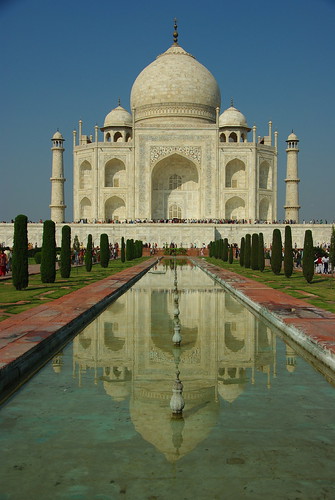
Taj Mahal: You’ve probably heard of this place…

January 14, 2011 By Jillian

IMGP1015So back to our story, which I think we left off in mid-December. You may remember the chaos of Mumbai . From there we jet set to Delhi to meet up with some of my sister’s coworkers. With an amazing local as our guide, the group of us set off for Agra and the Taj Mahal…

Bumping along the road, we drove through the outskirts of modern Delhi stopping every so often for a bite to eat or to pay a road tax. The last time we were driving around in a car we were in Africa. This time instead of people shoving meat on a stick through the window or jamming drinks at you, we had Indian animal charmers. You think I’m joking, but stopping on the way to Agra to pay a tax, our car was politely approached by a boy and his monkey, several men selling jewelry and what appeared to be another boy with a snake in a basket. Slightly more exotic than the offerings in Africa…

Arriving at the Taj Mahal was nothing less than intense. As we pulled into the parking lot, the car was accosted by local entrepreneurs trying to sell all sorts of “marble” knick knacks, Taj Mahal snow globes (apparently very popular) and a few Indiana Jones like whips. I can only guess what purpose the whips served. IMGP0977One rather jovial whip salesman, whose goods were topped off with a tuft of hair, persistently tried to get Danny to buy one. Unwilling to negotiate, we shrugged him off, hopped on a camel and … well slowly made our way to the Taj Mahal gates.
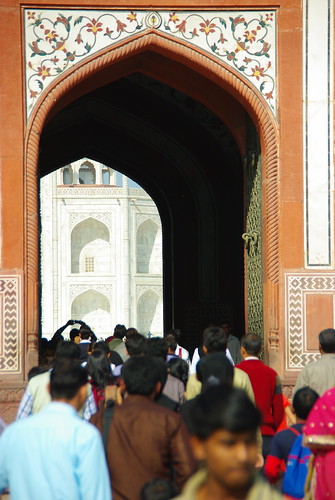
Security in India is everywhere. Since the Mumbai attacks in 2008, the Indian populace has submitted to opening their bags, being xrayed and in some places even being patted down before they enter a public place like a shopping mall or museum. The women’s line at the Taj Mahal was an interesting cast of characters. Swathed in colorful saris, women of all ages stood in line, and well, looked at us. A large school group of girls, meticulously clothed in their navy and white uniforms shyly giggled as we walked up. When their teacher motioned for us to pass through before them, each girl stared at us, shifting their eyes down as we approached. Finally one spoke up. “Hello, how are you?” She asked. Her classmates dissolved into giggles as we responded, and we walked up to the security area like queens, greeting each girl along the way.
IMGP0998

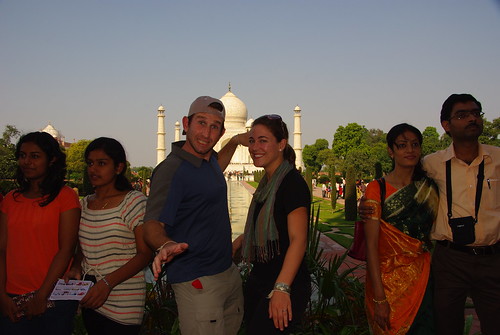
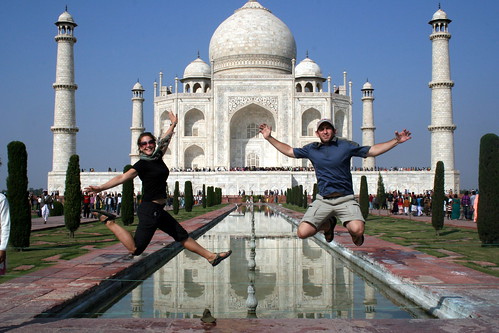
The Taj Mahal itself didn’t disappoint. Sure it was crowded, but as we jostled around trying to get our “jumping” picture we were greeted and smiled at by nearly everyone. Some even tried to get us in their family photos, and many tried to get into ours.

We spent a few hours at the Taj Mahal, mostly waiting in line and exploring the grounds. So much time in fact that after a long, delicious Indian lunch we were too late to get inside the Agra Fort. Failing to talk our way in after the gates were closed, Danny was hounded by a street vendor to purchase a wooden chess set, which he finally gave in and purchased when the price had fallen from $20 to $2.
IMG_3330

Driving is always an adventure, so I’ll end this post with perhaps the most incredible road experience of them all. We’ve driven through elephant herds in Africa, by penguins in Argentina and even a yak or two through Central Asia, but nothing compared to the traffic jam caused by the weddings on the road back to Delhi. For what seemed like hours we waited for bridegroom after bridegroom to make his way to the various wedding venues along the route. Flanked by an entourage of musicians, colorful lights, music and family members, an Indian bridegroom rides atop a horse or an elephant, arriving at the wedding location like a maharaja.

IMGP1070

The road from Agra to Delhi is full of wedding venues, and since we happened to be in India for peak wedding season, every one of them was full. Displays of fireworks, bands and spinning lights met us every few minutes and the traffic backed up for miles. No one seemed to mind at all…
Filed Under: Asia & Oceania, Headline, India Tagged With: monument, people

Mumbai: Surrounded by 17 million people

December 15, 2010 By Jillian

Getting to the commuter train station in a suburb of Mumbai, I was shocked when the seven car train pulled in full and hundreds of people on the platform moved to get on. Loading and unloading the train was a well choreographed dance and unfortunately we didn’t know the steps.

Mumbai Trains: 8 Million Passengers a Day
Thanks to babasteve on Flickr for this photo!

Welcome to Mumbai.

I was prepared for India, or so I thought before we got to Mumbai. Heavily traveled, we’d heard countless stories and warnings about the subcontinent. Love it or Hate it we were told and I was prepared to do both. Pity flashed in other backpackers eyes as we said we were going to India as a “break” before home. One guy looked at us like we were crazy and remarked that we must be literally out of our minds to look for peace and quiet in India before going home. Ouch.

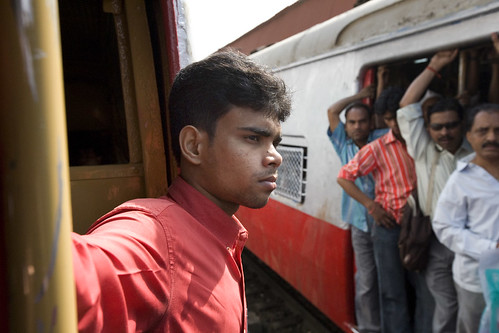
Flash forward to that train platform where the air was so thick and hot you could cut it with a knife and the platform was so busy that the flow of people reminded me of a fast moving river current. The train I would learn, was a microcosm of Mumbai. As Becka and I crowded onto the women’s car and found a seat, the women around us looked at us in curiosity. Dressed in brightly colored sari’s, shalwar kameez, scarves, western clothes and jewelry they were a sight to behold. This was exactly what I was expecting I thought. Looking out the window trains passed us, crowded to the brim, many with men hanging half way out of the cars holding onto handles. There’s a scene in Slumdog Millionaire where Jamal and his brother are riding the rails. It’s chaotic and colorful and all I could think about on that ride was how much it was just like the real thing.IMGP6640

Riding the trains wasn’t all movie magic. Opting always to ride in the women’s car, Becka and I often had to separate ourselves from Danny as the train pulled in and run for the women’s car. Generally this was no problem, but hitting the trains at rush hour we experienced the Mumbai shove. Imagine 100 people jammed into space for 50. That’s what it felt like on the train and as we tried to push and shove our way on and off, the Indian women around us gave us helpful, but hard shoves onto or off of the train. It was always a congenial group of women, but women very serious about getting on and off the train. We emerged each time feeling like we had just been born.

The men’s cars on the other hand weren’t as congenial and Danny had to use some of his rugby skills to get off the train. Pushing and shoving, the crowd seemed to swallow him alive and his emergence on the platform was something more akin to Jonah being spit from the whale than being born. With his day-pack tucked carefully to his torso like a rugby ball, he hunched down and barreled his way towards the exit, launching himself onto the platform as a result of various well placed elbows.

We were pleasantly shocked every time we made it on and off together. Of course there was the time when we didn’t all make it on or off the train, but really that stories better to tell in person.

Filed Under: Headline, India Tagged With: cities, people, transportation

Haven’t we meet before?

October 25, 2010 By Jillian

IMGP8349The world is a small place, even on the road, and it’s not unusual for us to run into people again on this journey. Usually it is within the same country, but in Chengdu we were fortunate enough to run into our couchsurfing hosts from Buenos Aires. Of course it wasn’t exactly serendipity (no frozen hot chocolate either), but it was a welcome break to see a familiar face.
You never know when people are going to walk back into your life and sitting in the hostel one evening another surprise- in walked in an expat couple we had met in Xinjiang province. Small worlds collide in Chengdu and for a few days it felt like we were back at home hanging out with friends. Needless to say we spent a few extra days in Chengdu soaking it all in.

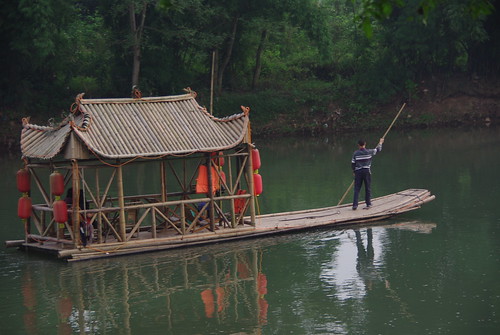
Thankfully there was a lot to do in and around Chengdu and we treated ourselves to a few special travel treats. Heading out to the country side we spent a day near Ping-Li, an old feeling village about 2.5 hrs from Chengdu. The town was touristy and although we spent a lovely afternoon being poled up and down the river on a reed boat drinking green tea and chatting away, the best part of the excursion was hiking through a tea plantation. Upon our arrival at the tea plantation we weren’t sure what was going on. We were served tea, but it became clear we had interrupted some sort of meeting. As time went on we became convinced we were part of a local communist party meeting, which may be in truth unlikely, but it still makes for a fun story.

IMGP8359Exploring the tea plantation and the bamboo forests surrounding it was peaceful and completely different than the chaos and hassle of big-city China. It was a relaxing way to spend a few hours and frankly one of the best things we did in Chengdu.

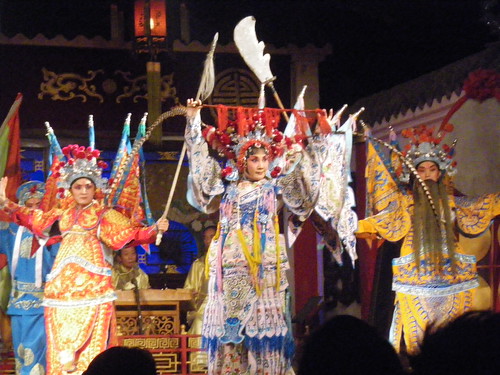
The other treat was the Chengdu Opera. Opera isn’t really the right word for the show we saw, it was more like a variety show, and although clearly for [mostly Chinese] tourists, it was very entertaining. From shadow puppets, to marionettes, to true operatic performances and violin-like solo’s, the show was lively and for the first time in a long time we had a taste of the local professional performing arts. Perhaps the most interesting part of the show was the up-close show by the tea-pourers. Holding the tea in large brass tea pots with spouts well over a meter long, the tea-pourers seemed to be able to shoot the tea out of the spout into your cup several inches away. It was an incredible presentation and not once did our pourer spill, even across four people!IMGP6096

IF YOU GO: Try to combine a tour of Ping-Li with a tea plantation. We hired our own taxi for the day through our guesthouse. Ping-Li is very touristy, but we enjoyed wandering around after dark. Trips to the Chengdu Opera shows can be arranged inexpensively through lodgings, and often freebies- such as a VIP upgrade (which basically just means unlimited green tea) transportation and a tchochky are included. We stayed at Sim’s Cozy Garden, after first staying at another less nice place….we recommend you do the same.

Filed Under: Asia & Oceania, China, Headline Tagged With: friends, normal, people, tea

Who are the Central Asian People?

September 30, 2010 By Jillian

As the center of the Silk Road, Uzbekistan has a long history of diversity. Not surprising given that traders mingled here for hundreds of years bringing goods from Southeast Asia, China, the Persian Empire, Europe and the Middle East through the region. With their goods of course came people, wives, children, servants and slaves. Then there were the conquerors who ravaged the land looking to cash in on the wealth and—before getting too far into the region’s history—you have probably the most unique melting pot of races, ethnicities and cultures in the ancient world. Uzbekistan was probably the world’s first global society.

IMGP7522Some of that diversity remains today. Populations of Koreans, Chinese, Russians, Persians, Turks, Nomads, Christians, Muslims and Jews live together and although the trading has moved away from silks and spices, the society functions much in the same way. A relatively sizable Jewish population still exists in Bukhara, although more and more move to Israel every year. Sephardic, the population maintains its religious piety, synagogues and community centers still exist. Tashkent even has a few Korean barbecue restaurants and a sizable Western expat population. Mixing the pot a little more, Tashkent’s lingua franca is Russian while in Western Uzbekistan the people mostly speak Karakalpak, a Turkic language.

IMGP7545A look at the people tells the land’s history. The Uzbek people are a complete racial mix, and its unlikely that you can pick out a predominate feature. Their features are mixed: a handful of faces topped with blond hair, seem to shout “Alexander the Great was here,” while most others, with straight black hair and distinctly Asian features are definitely relatives of the nomadic peoples that populated this area. Some look like they belong in India or Pakistan while others just defy profiling. Traditional clothing ranges from highly patterned Asian silks to sparkling velours and square hats that remind us of Turkey and other Islamic states.

Their way of life may be different than our own, but their faces tell the history of the world.

Filed Under: Asia & Oceania, Headline, Uzbekistan Tagged With: culture, people, race

In love with Lamu

April 12, 2010 By Jillian

33 hours after leaving Kampala we arrived in Lamu cranky, exhausted and rattled to the bone. Fortunately we had a nice place to stay courtesy of Nikki’s professor, and dropping our bags in his kitchen we felt an instant wave of relief.

On the northern coast of Kenya, Lamu embodies traditional swahili culture, and stepping onto the island is almost like stepping into a different world. Donkey’s bray, men call out to each other in Kiswahili, Arabic and English, trading and inviting you into their shop with a genuine smile and a welcoming hello. Traditional Swahili homes covered in coral, stone and white plaster form two story walls that shelter passersby in the shade and bathe them in geometric patterns of sunlight. We had never been to Lamu before, but we felt comfortable, like we were at home.

Immediately having felt so welcomed, we weren’t surprised when we were approached by Ali Hippy, an infamous presence to tourists on the island. As he always notes, he is listed in that dreaded guidebook- lonely planet. Inviting us to his home for a traditional swahili meal, for a price of course, and some entertainment, we hesitantly agreed and forked over our cash for a meal the next evening. Sure enough, he took us to the “coconut beach” where his family lived and where we found a multi-course seafood buffet prepared. Small dishes of lobster, prawns and chapati, tuna and coconut rice delighted our tastebuds. As the meal wound down and Ali Hippy started to sing, the neighborhood children wandered in to join. Full of music and the scent of swahili food, the evening was a delight and we walked home that night with fully bellies and happy hearts.

Enchanted by the atmosphere and the island around us we spent our time in Lamu wandering the maze of streets, exploring the beaches and getting to know our neighbors. The silversmith who lived next door made jewelry out of old pottery that often washes up on shore, leaving us with an empty wallet and a jewelry box full of beautiful pieces. We shared fruit with our neighbors and curious about the food we had eaten at Ali Hippy’s wrote down recipes from the home’s care taker. With him we shared delicious red snapper, happy conversation and many laughs. Every time Danny would return from the market the care taker would ask how much Danny had paid for whatever item. Inevitably this became a joke, with Danny consistently paying nearly double the local price, until one afternoon when Danny produced what he thought was a bag of peanuts. To his chagrin the rest of us immediately recognized a bag of beans, not peanuts. Laughing, Danny asked how much the bag of beans should cost. To his surprise, we were told 40 shillings. Danny had only paid 35. It was a victory, if his only one.

Lamu and its surrounding islands were important trading posts on the Indian Ocean trade route, giving rise a few centuries ago to a Swahili trading empire along the coast of present day Kenya and Tanzania. Trading ivory, mangrove wood, and slaves, Lamu flourished as a trading center in19th century drawing Arab, Indian and even East Asian traders to its shores. Surviving from the height of its prominence in the 19th century are intricately carved doors and furniture,the patterns of which are still replicated today in jewelry boxes, door frames, furniture, and even board games. We were in awe of the beautiful wood carvings, so much so that we had a special boa board crafted for us by a neighborhood carpenter.

Like Zanzibar, Lamu’s mix of cultures survives today, giving the place an air of exoticness. Sailing through mangroves towards Swahili ruins on a nearby island, I felt like we were in a secret world. Completely alone at the Takwa ruins, not a single other tourist in sight, we explored the ancient coral structures and sat for a long time on the beach watching pink crabs scurry about. It was practically perfect, a blissful place removed from the chaos of our world.

It is hard to top off a visit like ours to Lamu. For our last evening in Lamu, we were invited to the home of Nikki’s professors friend, a local born and raised in Lamu. Having spent a fun afternoon with his wife and two small children at the Takwa ruins, we were looking forward to an evening with the whole family. Over a delicious spread of stews, prawns, rices, cakes, beans and tamarine juice (a new favorite!) we discussed ideas, politics and the world. Sharing our ideas, perspectives and experiences was a wonderful cultural experience, which further reinforced that we are all the same, same, but different. It is a memory we will always treasure from a place it will be hard to forget.

Filed Under: Africa, Food, Headline, History & Culture, Kenya Tagged With: cultures, islands, people, sharing, travel

  • « Previous Page
  • 1
  • 2
  • 3
  • 4
  • Next Page »

Connect With Us

  • Email
  • Facebook
  • Flickr
  • Pinterest
  • RSS
  • Twitter

Featured Posts

Our Bucket List
How We Travel For Free
$ Travel Tips

Recent Comments

  • Barbara on Kayaking Kauai’s Na Pali Coast
  • Lori Hubbard on Review: Eneloop Batteries and Charger
  • TK on The Trouble with Philadelphia

Banking on the Road

It can be very hard to keep track of your finances while you're on the road long-term. Be sure to check out how we took care of our finances while traveling and feel free to email us any questions you have.

Adventure Guides

Torres Del Paine
China Adventure
Uzbekistan Overland
Egyptian Odyssey
Malaria
Argentina Adventure
DIY African Safari
South Africa Guide
Bolivia by Bus
How-To African Visas

[footer_backtotop]

Copyright 2008-2015 · All Rights Reserved · Contact I Should Log Off · RSS · Partner With Us · Privacy