• Home
  • About
    • Who We are
    • Affiliates
    • Disclosures & Guidelines
    • FAQs
    • Privacy Notice
  • Funding Your Travels
    • Banking on the Road
    • Credit Cards in Our Wallet
    • Spending
  • Contact
    • Media
    • Submission Guidelines
    • Partnership Opportunities

i should log off

log off and live!

  • Travel & Planning
    • Travel Reflections
      • Good, Bad & Ugly
      • Re-Entry
    • Travel Resources
      • Travel Tips
      • Travel Bloggers
    • Reviews
      • Gear
      • Operators
      • Travel Clothing
    • Travel Gear
      • Cameras
      • Danny’s Clothes
      • Electronics
      • Health & Hygiene
      • Jillian’s Clothes
      • General Gear
  • Destinations
    • Travel Guides
    • Africa
      • Egypt
      • Ethiopia
      • Lesotho
      • Kenya
      • Malawi
      • Morocco
      • Mozambique
      • Namibia
      • South Africa
      • Sudan
      • Swaziland
      • Tanzania
      • Uganda
      • Zimbabwe
    • Asia & Oceania
      • Armenia
      • Cambodia
      • China
      • Georgia
      • India
      • Kazakhstan
      • Laos
      • Thailand
      • Turkey
      • Uzbekistan
      • Vietnam
    • Caribbean
      • Antigua
      • Cuba
      • Jamaica
    • Central America
      • Belize
      • Costa Rica
      • Guatemala
      • Honduras
      • Nicaragua
      • Panama
    • Europe
      • Armenia
      • Austria
      • Belgium
      • Czech Republic
      • France
      • Georgia
      • Germany
      • Hungary
      • Italy
      • Spain
      • Turkey
    • North America
      • Canada
      • Mexico
      • USA
    • Middle East
      • Egypt
      • Israel
      • Jordan
      • Oman
      • Turkey
    • South America
      • Argentina
      • Brazil
      • Bolivia
      • Chile
      • Colombia
      • Ecuador
      • Peru
      • Uruguay
  • Weekend Adventures
    • Cycle
      • Pastimes
        • Beer & Wine
        • Books
        • Cooking
        • History & Culture
    • Dive & Snorkel
    • Hike
    • Trek
    • Whitewater
  • Photos
    • Photo of the Day
  • Family Travel
You are here: Home / Archives for Destinations / Central America

Isla de Ometepe

June 22, 2009 By Jillian

After Leon we spent a few days in Granada, relaxing and taking in the city. From there it was a quick jump to Isla Ometepe. The largest freshwater lake in Central America, Ometepe is a budding outdoor adventure paradise. Visited but not overrun by tourists, Ometepe maintains is “wild” feel. Dominating the landscape Volcan Conception and Volcan Maderas provide hiking, animal, birdwatching, and even swimming. Combine that with the lake shore, lake kayaking and even a wild monkey island, and well, you see why we had to spend a few days there.

Heading to Isla Ometepe via ferry we disembarked in Moyogalpa and quickly scrambled onto a chicken bus towards the village of Merida. Two and a half hours later we found ourselves at Hacienda Merida, an Eco-friendly, sustainable development focused inn along the west side of the lake. Checking in we were greeted by Simeon, a guide from the local tourism cooperative who cajoled us into hiking Volcan Maderas the next day. Unable to pass up an opportunity to climb another volcano, we singed up for the climb. Cautioning us not to drink and to get a good nights sleep Simeon left us until the next morning. Needless to say after all day traveling by overcrowded chicken bus and the slowest ferry imaginable, we needed beer and headed down to the local commedor for dinner and some brew.
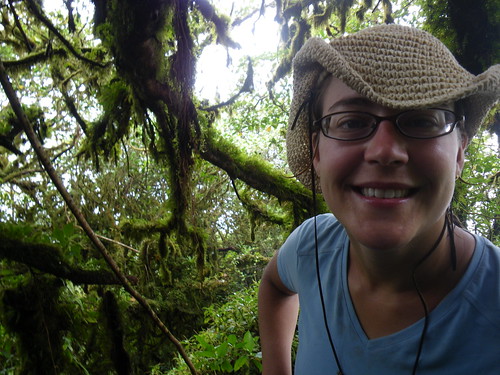
Thinking we might actually beat the roosters to call in dawn, we left the Hacienda around 6:30am prepared for an 8-10 hour hike to the summit and back. Since the volcanoes basically are the island, there isn’t much flat terrain and we spent the first hour gradually climbing through agricultural fields. Heading into the canopy the trail became exponentially harder and we often found ourselves climbing up muddy tree limbs precariously balanced on their roots. Huffing and puffing like couch potatoes going up the stairs, we were challenged by the hike, heat, and humidity. Literally dripping with sweat, we continued to breathlessly ascend the volcano. I’m not sure if it was the rapid speed of the guide, he told us he climbs the volcano at least three times a week with tourists, the heat and humidity or the previous nights beer, but I felt incredibly out of shape for the first time in a long time. Before traveling both of us exercised daily and participated in adventure races and extreme sports. Three months of rice and beans has clearly had an affect on our bodies.

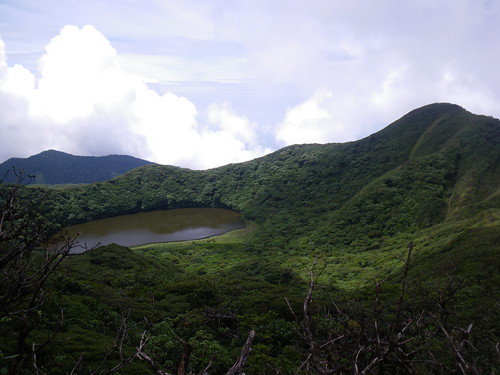
Easing up a bit as we got to the summit, the trail continued past the summit towards a Laguna. All of our huffing, puffing and sweating were rewarded by beautiful views of the Laguna from the summit. Resting a moment, we broke out some snack and chatted with the guide before heading back down the volcano. Nothing good lasts for long, especially in rainy season and before long the afternoon sky opened up on us and we found ourselves hiking down in a river of mud. One thing we’ve learned being in Central America during rainy season is that post afternoon shower the jungle is alive with all sorts of creatures. Almost back to the agricultural fields we spotted Capuchin monkeys interested in playing or at least looking at us. Calling to them with a series of kissy noises and what sounded like Donald Duck calls, Simeon got a few of the curious ones to come closer to us and we watched them leap through the trees above our heads.

Continuing down the mountain I made a few friends of my own, unfortunately they were not the cute furry kind. No my friends, I formed a bond with the Chichicaste plant, infamous for the painful blisters that form after you come in contact with it. Needless to say I found the plant by accident. I may not be allergic to poison ivy, oak or sumac but I am certainly not immune to the charms of the Chichicaste plant. Hauling myself down the volcano, Simeon proceeded to point out every single poisonous plant on the way back down and warning me about each one. Finally, soaked, exhausted and each of us hurting in our own way, we collapsed in a pill of mud in front of our room unable to move for at least ten minutes.
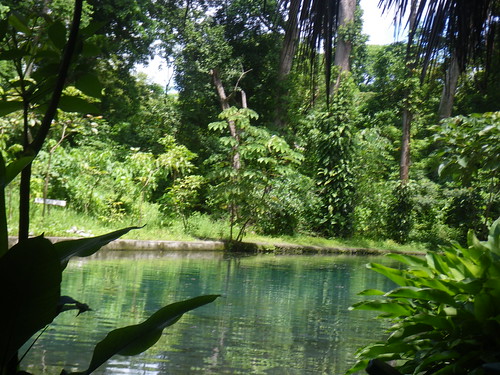
Healed from my encounter with the Chichicaste, but still exhausted we decided to take the next day easy. Closer to Volcano Conception, the pools of Ojo de Agua (eye of the water) were an incredible place to rest our weary bones. The two pools of varying depths, naturally filled with river water, were downright cold and refreshing after the jungle. Things being what they are though, we miscalculated the money we brought with us and found ourselves without enough cash to take the bus back to Merida. Doing what any good independent traveler would do, we hitched a ride in the back of a utility truck to the nearest town and walked the 8 km back to Merida.   Turns out our lack of money didn’t matter. Not a single bus passed us the entire way back to Merida -we would have been waiting over two hours for the bus anyway.
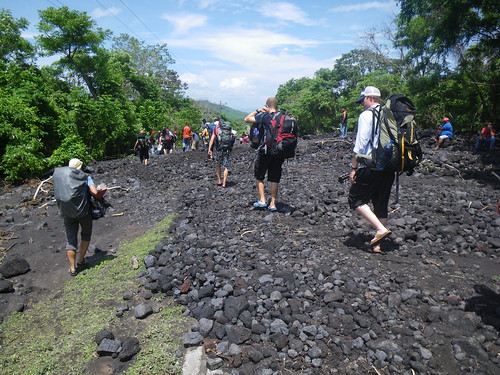
Crawling into bed to once again torrential downpour, we slept like logs. Heading back to Moyogalpa the next morning our bus abruptly stopped about 10km from the town. Herding us out of the bus like cattle, the driver pointed to the road ahead and told us we’d have to walk to the connecting bus. The torrential downpours we keep talking about? Well they had triggered a massive landslide overnight that covered everything in it’s path with mud, volcanic rock and debris. Eventually we made it to Moyogalpa,  and in a panicked rush, caught the ferry and made it back to the mainland.
Filed Under: Central America, Hike, Nicaragua Tagged With: hiking, transport, volcano

Volcano Boarding

June 17, 2009 By Jillian

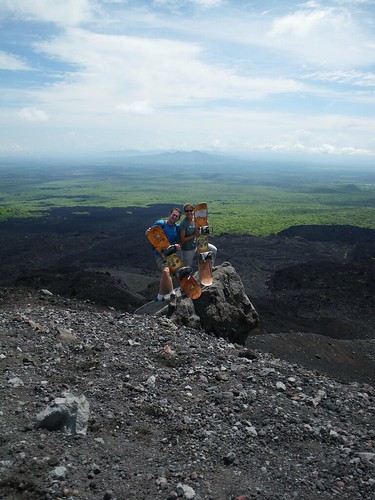
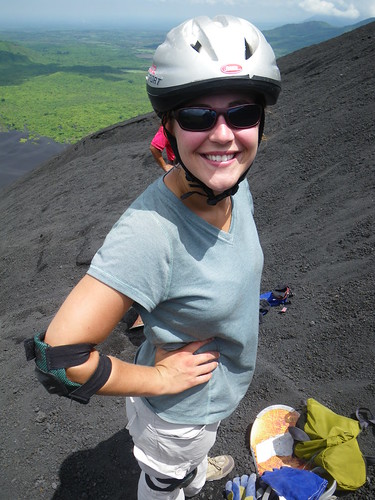
Volcano Boarding in NicaraguaStanding at the top of the volcano looking down I nearly backed down.   Looking down what seemed like at least a 60% grade I could only see the first half of the run.  Volcano boarding sounded cool and looked cool, but I was sure that I was about to severely injure myself.  I know, I know, what kind of adventure travel blogger am I?  Assuring us it was easy, our guide Wilbur boarded for about ten seconds before turning around and telling us “the first 10 seconds is scary, then it gets easy”.   Hmm, I had my suspicions.

If you know me then you know I hardly back away from anything and after climbing up the volcano in 90 degree weather for over an hour there was no way, no matter how scared I was that I would turn around.  I just had to convince myself that I wouldn’t die in the process.

Clipping into my bindings, I angled the board towards the bottom and quickly headed down the volcano.   I’ll admit, it was much easier than it looked and I had no trouble maneuvering the board or controlling my speed.   In fact most of the way I wanted to go Crater of Cerro Negro in Nicaraguafaster not slower, but had a difficult time clearing the volcanic rock from my board.  I quickly felt confident enough on the board to try jumping and carving a little.  Cruising to the bottom without much excitement (really no falls or anything!) I turned around to see Danny flying down the volcano.

As part of the briefing our guide casually mentioned to Danny that his board was “slightly” faster than the others.    According to Danny it was more than slightly faster.  Although I missed seeing it live (I was cruising down on my own), Danny had an “eventful” time heading down the volcano.  I think the video speaks for itself:

Congratulating ourselve at the bottom for making it down, we all agreed that a ski lift needed to be installed.  There was no way we were hiking back up that steep grade with the boards, but we definitely wanted to do it again.

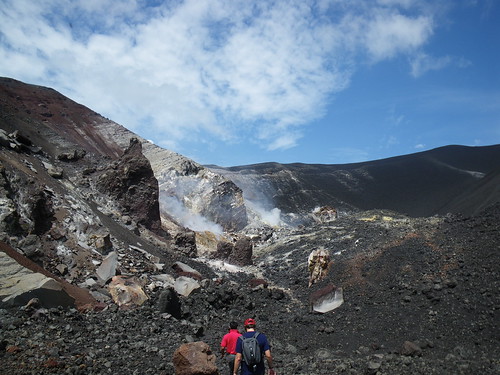
Volcano Boarding Cerro NegroThe walk up Cerro Negro was also spectacular in its own right.  Sure we’ve already been mere inches away from lava but it was nice to tour inside an active crater, feeling the heat from the activity just and below the surface, and smelling the sulfur.  Hiking around the rim of the crater we could feel the heat eminating from the ground and looking out at the surrounding valley it was easy to see the destruction this volcano had caused in its short lifespan.  The youngest volcano in Central America, Cerro Negro appeard about 150 years ago transforming the topography of Leon.  Erupting several times since then the last significant eruption was in 1999.  With all of the steam, heat and activity instide the crater, I agree with the locals, it can’t be long again before another.

Interested in Volcano Boarding? Check out our Volcano Boarding Review!

Filed Under: Central America, Nicaragua Tagged With: hiking, tour, volcano, volcano boarding

La Mosquitia- Part II

June 15, 2009 By Jillian

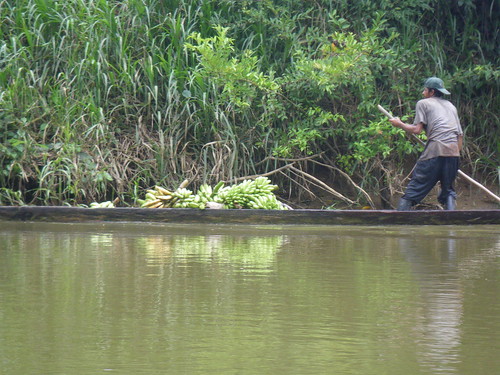
Fortunately years in the outdoors has taught me to always “be prepared”, so after the sea turtle encounter we set off into the jungle with more than enough food, our Steri-pen and what we thought would be enough 100% DEET to kill every mosquito in the area. Feeling like real adventurers for the first time on this trip, we motored up the Rio Platano. Not densely populated, but clearly inhabited, we were often greeted along the river banks with “Hola” and a wave, the children at least seemed excited to see us. As we journeyed further up the river, the shelters spread out significantly and it became clear that we were beyond the reach of the every day Western world. In our motorized dugout canoe we slowly moved upstream for almost five hours before reaching our jungle hospedaje.

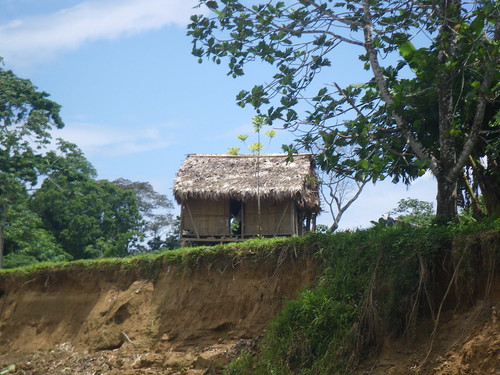
Arriving at the hospedaje felt something like a national geographic documentary. As the canoe pulled up to the sandy bank the children ran down the hill to greet us. Quickly settling into our rooms and introducing ourselves to the extended family, we explored the village of Las Marias. Nestled in the jungle, the village is a cluster of about 500 families, many of whom are part of an eco-tourism cooperative. Formed more than a decade ago, the cooperative provides guides and tours of the Rio Platano Biosphere Area for visiting tourists. Organized so that the work is shared amongst the guides and boatmen, a saca guia (head guide) greets incoming tourists and provides an overview of the activities and tours available in the area. We were the only tourists at Las Marias at the time, so chatted with the saca guia and our hosts for a while before deciding on two day jungle hike to Pico Balitmore.

Setting out the next morning, the saca guia picked us up at our hospedaje to introduce us to our guides, Jose and Har. Indigenous men from the area, they showed us the way up Pico Baltimore through deep mud, jungle heat and humidity. Walking and chatting with the guides, we learned about their families, culture and their experience with tourists. Both of our guides had grown up as a part of the eco-tourism cooperative so their perspective on tourism was incredibly interesting. Well aware of the potential negative impacts of tourism, both men felt that the increase in tourism over the last several years had been good for the village and had provided many families with a decent income. Excited not only to be having the conversation in Spanish (thank you spanish teachers in xela!), but that we were in a place where our tourist dollars were making a palpable positive impact in the community I continued to press them on the subject and the impact of tourism development. Las Marias lack running water, electricity and communicates with other villages through two way radio. For the most part Jose and Har wanted basics that were currently unavailable, mainly medical care and a better education for their children. Aware of conveniences of the outside world, not just from tourists but also from family living outside of La Moskitia, Jose replied that they did not need electricity or kitchen appliances, what they needed was a cell phone tower to communicate with each other. Initially I scoffed at the idea that a cell phone town should take precedence over electricity or running water. I later came to realize that this was the true impact of tourism, that they should understand their own needs better. Jose did not want to change their way of life so much that it became like ours, he just wanted to be able to communicate better.

Trekking through the jungle was tough. It was hot, humid and extremely muddy. Although there was a faint path through the foliage, the jungle was dense and more often than not our guides macheted a path for us. I had to keep reminding myself that it was about the journey not the destination. Just before reaching our evening accommodations deep in the jungle, Jose stopped us silently in our tracks. Listening intently to the sounds of the jungle we heard a loud screech. White faced monkeys swung through the trees off to our left, screeching and playing. Reinvigorated, we continued on to the thatch roofed cabana where we promptly collapsed from the heat. Waking a few hours later we found dusk had descended and with it the onslaught of mosquitoes and other unidentifiable large jungle insects. Not to mention the 4 inch scorpion in the cabana….

Cooking dinner on an open fire, we shared our food with the guides, introducing them for the first time to chicken hot dogs. Without buns, veggies or even ketchup (everyone from Chicago is now cringing I know), the guides proclaimed the hot dogs “muy rico” (delicious) and encouraged us to save the rest for the following morning.

Hiking out the next day in a torrential downpour we pulled into the hospedaje wet, exhausted but very happy. Despite scorpions, spiders, and hundreds of mosquito bites it was an incredible cultural experience that I will never forget. As we motored downriver early the follow morning I felt protective over the people on the riverbanks silently hoping that sustainable tourism continues in this region, bringing prosperity without destroying their culture and way of life. Although we’ve been to a number of small communities on this trip, we haven’t been in a community on the edge of sustainable growth like this before. The ability of this community to band together and form a cooperative (with the help of a NGO) and continue to grow in such a way is a great template for other emerging tourist communities throughout the world. I hope as we continue to travel we find more of these unspoiled cultural gems.

Filed Under: Central America, Honduras, Trek Tagged With: culture, hiking, jungle, tours

La Moskitia Part I

June 11, 2009 By Danny

Although we had read about La Moskitia in our guidebook, we figured that without proper gear and equipment a trip into the “jungle” would be virtually impossible. Plus we figured it would make a great trip later in life, you know when we are just “vacationing.” All but giving up, we resigned ourselves to move on to Nicaragua. As luck would have it, we met an American in La Ceiba who had just come out of La Moskitia, doing the entire trip independently without a tour agency. Excited, we plugged him for details about cost and conditions and it soon became clear that not only was it completely do-able to see some of La Moskitia on our own, it was well within our budget.

La Moskitia is called the “Little Amazon” by some.  By others it is called jungle. Still by others, it is called home. Several indigenous groups, mainly Moskito and Pech, live in this foreboding wilderness where they still speak their native languages…and Spanish. Additionally, some archaeologists believe that the fabled lost city of the “White Maya” may be hidden within the region.

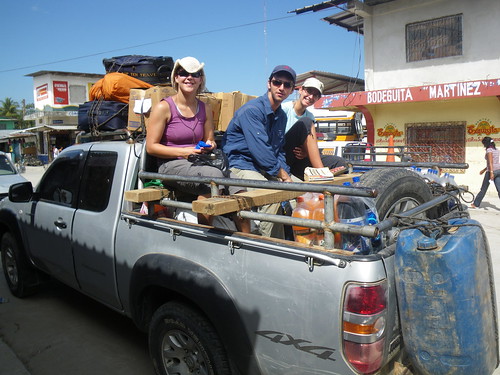
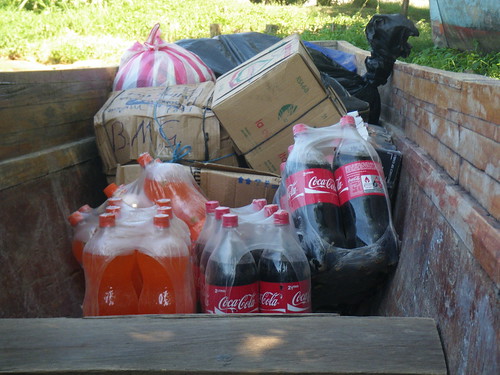
We began our trip into the jungle in a small city called Tocoa where we found a pickup truck (oh, there were many to choose from) that would take us ‘out there’. The ride in the back of this truck, jammed in with other people as well as essential supplies (mostly Coke & Pepsi products) for the villages we would pass along the way, was quite the adventure in itself. Once the paved road ended, the dust picked up and we found ourselves breathing dirt as we sped along. This didn’t last forever though as the dirt road quickly ended as well…meaning it was time for the beach. Speeding along the Caribbean shore at unknown speeds we’d feel the splash of the ocean and then lurch forward as the driver slammed on the brakes to avoid the incoming tide, a piece of drift wood, or the occasional horse. We sped along holding on for dear life for about an hour and a half as we stopped in several Garifuna villages dropping and picking up passengers and supplies. Finally, very much needing a beer to calm my nerves after the ride, we reached the extent of the “road” and hopped on a boat for the village of Plaplaya.

We chose to sleep in Plaplaya this first night because we’d read it was turtle nesting season and there would be the opportunity to search out nests or release baby leather back turtles into the sea. Upon reaching Plaplaya we learned that this was all there was to do there…with the exception of killing exceedingly large spiders so that Jill would finally allow me to go to sleep. We introduced ourselves to Ismael who was the local turtle researcher and agreed to meet up after dark for a search of nests.

We began our walk, which Ismael clearly thought would be a waste of time. After walking for about 3 minutes we were rewarded. No, we didn’t happen upon a nest, we happened upon the biggest turtle I’d ever seen in my entire life. The leather back was simply huge…way bigger than those so called giant tortoises that move two feet per year at the zoo. Probably about the size of a Manatee (don’t forget, we call those cows) so it was quite huge. When we arrived it had already dug the hole (about a meter deep) to drop its eggs, but no eggs yet. Watching its movements reminded me of Disney World where you watch the anamatrnoic machines on the rides, it was just completely alien.

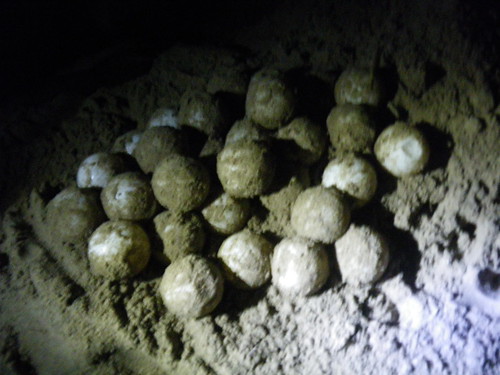
Eventually her eggs began to drop and from behind her we were able to see them fall and accumulate. Ismael set to removing them from the nest in order to bring them to a breeding facility where they would be kept safe from other animals [and humans] who would otherwise make a tasty snack. Ismael let us touch the racquetball sized eggs which were surprisingly soft and dented easily; makes sense given how they all fall. He also let us touch the shell of the mother turtle which was unsurprisingly leathery. By the time she was finished she had dropped 99 eggs and one small golf ball bit of food for her young once they hatched.

With the sand flies wreaking havoc on our feet and the eggs needing to be brought back for protection we ultimately called it a night and headed in. All told our encounter lasted probably less than an hour but watching something so alien give birth was incredibly special.

Filed Under: Central America, Honduras Tagged With: animals, hiking, jungle, tours

La Moskitia Notice

June 8, 2009 By Jillian

Headed deep into the jungle of La Moskitia (of -movie- Mosquito Coast fame!) a few days ago (scheduled this post to upload) so we won’t be back for a few more days yet. Don’t worry, although the name implies its Mosquito heaven, the region is actually named after a local indigenous tribe, the Miskito. No electricity means no hope of Internet so we’ll post again when we return.

Filed Under: Central America, Honduras Tagged With: jungle, notice

  • « Previous Page
  • 1
  • 2
  • 3
  • 4
  • 5
  • 6
  • …
  • 8
  • Next Page »

Connect With Us

  • Email
  • Facebook
  • Flickr
  • Pinterest
  • RSS
  • Twitter

Featured Posts

Our Bucket List
How We Travel For Free
$ Travel Tips

Recent Comments

  • Barbara on Kayaking Kauai’s Na Pali Coast
  • Lori Hubbard on Review: Eneloop Batteries and Charger
  • TK on The Trouble with Philadelphia

Banking on the Road

It can be very hard to keep track of your finances while you're on the road long-term. Be sure to check out how we took care of our finances while traveling and feel free to email us any questions you have.

Adventure Guides

Torres Del Paine
China Adventure
Uzbekistan Overland
Egyptian Odyssey
Malaria
Argentina Adventure
DIY African Safari
South Africa Guide
Bolivia by Bus
How-To African Visas

[footer_backtotop]

Copyright 2008-2015 · All Rights Reserved · Contact I Should Log Off · RSS · Partner With Us · Privacy